SESH Academy

Full topic reading

From the basics to the details

Accords: several smells forming one impression

A material and a description are different things

An ingredient is a material in the formula. A note describes a smell you notice. An accord combines materials or impressions into a coherent character, such as floral, leathery or marine. Like musical notes forming a phrase, you can recognize the whole without separating every component.

A leather impression does not require leather

A perfumer can create leather, sea-air or clean-cotton impressions using different materials. An accord name does not prove literal inclusion of the named object. An amber description can refer to a warm construction of sweet, resinous and other impressions rather than dissolved amber stone. The term describes resemblance, not a manufacturing recipe.

A mixture can smell different from its parts

In mixtures, one impression may mask another or a new overall character may be hard to separate. Not identifying every listed note does not prove a fake perfume or a faulty sense of smell. Instead ask which impression dominates and whether a clear secondary aspect exists. 'Warm sweetness with wood' is a useful start.

An accord is more than a note list

An accord is a coherent smell impression created by combining two or more materials. One ingredient may be sharp alone but lend freshness in a blend, while another adds warmth or softness. The accord cannot be understood merely by counting its ingredients, just as a finished dish is not its ingredient list.

A safe practical comparison

Smell a fruity-sweet finished fragrance beside a clearly floral one on separate blotters. Describe the balance rather than just naming materials: does sweetness dominate or share space with freshness? Is a floral heart prominent or blended with woods? Use finished commercial fragrances for this exercise. Raw-material blending requires expertise in safe materials, limits and formulation practice.

What makes an accord?

An accord is a unified sensory impression formed by several odorants. Smell a fruity and a vanilla-like strip separately, then hold them near one another without combining liquids. Does the result evoke a dessert, or can you still identify both?

Balance is perceptual

One powerful component can mask others. Balance is not equal ingredient counts; it is whether the intended character is perceived.

ABC010203
Study sequence: observe the initial impression, repeat under controlled conditions, then compare your observations.

Apply it to SESH: explore the fragrance collection, compare each perfume’s note description, then test the scent rather than relying on copy alone.

SESH case study: Love by Sheeka describes peach and freesia in its opening, rose and jasmine in its heart, and vanilla, patchouli and vetiver in its base. Compare this note map with your own observations.
Sources and further reading

Balance: which impression stands out and which disappears?

Presence does not guarantee detectability

In a floral-vanilla perfume, sweetness may dominate enough to make the flower hard to describe. This does not establish that floral materials are absent. Mixture perception depends on interactions, the observer and time. 'I cannot distinguish rose' is more accurate than 'There is no rose-producing material'.

Describe character before judging balance

Balance does not require every note to be equally strong. A perfume may intentionally place vanilla upfront with background wood. Ask whether the desired character is present and whether one aspect overwhelms what you want. This is goal- and preference-dependent, not a rule that every mixture needs equal parts.

A simple comparative trial

Use two known finished products on separate strips. Observe A, pause, then B, then their joint impression. Record what increased, decreased or seemed new. Begin with comparable application amounts; changing both identity and amount complicates interpretation. This is not an exercise in mixing raw materials on skin.

An accord can mask an impression without removing the material

In a perfume combining pronounced sweetness with softer wood, the sweetness may dominate at first. As it subsides, the wood can become more noticeable. That does not prove a new woody molecule has appeared; it may have been present but perceptually masked by stronger notes.

A crucial language distinction

Write “I cannot perceive wood clearly right now” instead of “there is no wood in this perfume.” The former is an observation, the latter is a compositional claim. When judging accord balance, track which impression dominates and which becomes noticeable later without pretending to reverse-engineer the formula.

Practical sensory workshop

If a fruity-creamy accord feels dominated by sweetness, evaluate components individually and in proximity. Identify which facet masks the others before proposing any formula adjustment.

SESH exercise: choose two scents and record results before viewing their marketing descriptions.

Sources and further reading

How does the nose build a mixture impression?

A signal followed by interpretation

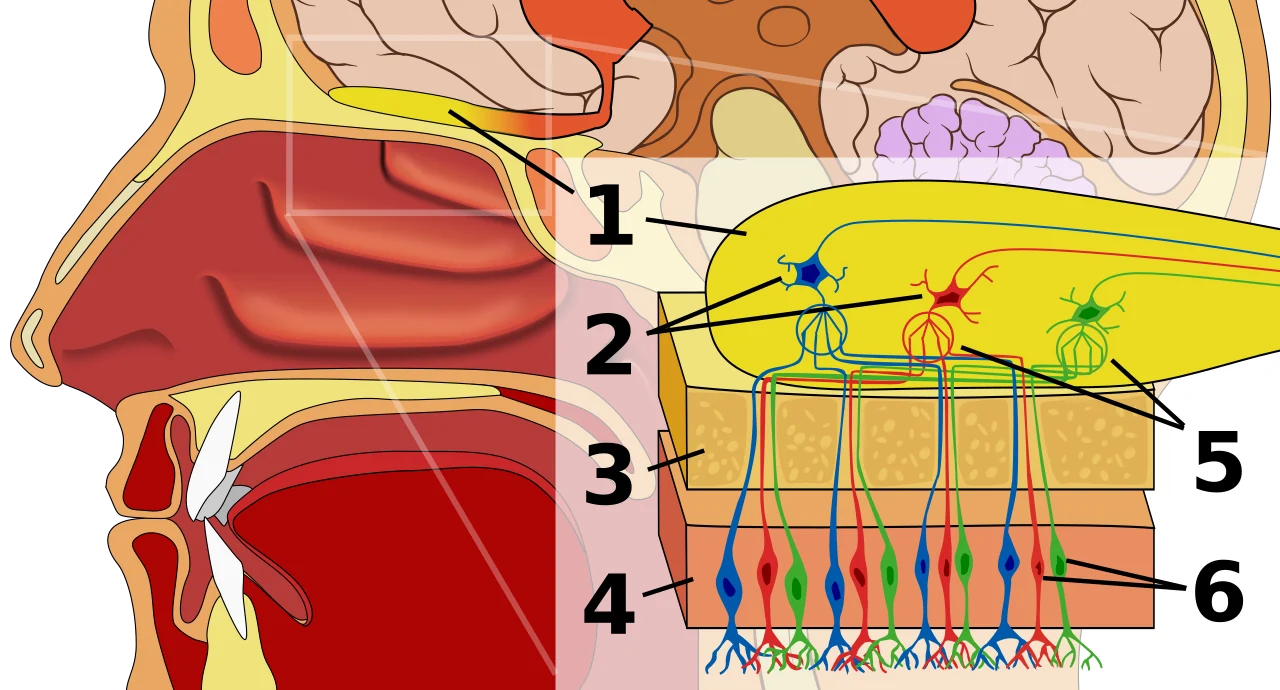
Sensory cells high in the nasal cavity respond to odorants. Signals travel to the olfactory bulb and brain regions involved in interpretation. The resulting experience depends on patterns, experience and attention, not one receptor for each marketing note name. Two people may detect the same smell yet label it differently.

Start at the sensory cells high in the nasal cavity, then follow their connection to the olfactory bulb above. Signals begin here; identifying the smell involves brain interpretation.

Start at the sensory cells high in the nasal cavity, then follow their connection to the olfactory bulb above. Signals begin here; identifying the smell involves brain interpretation.

Chabacano / Ignacio Icke, after Patrick J. Lynch · CC BY-SA 2.5 · Licence · Open the image to enlarge

Detection is not identification

Detection asks whether a smell is noticeable. Identification asks what it is or resembles. A smell can be clear without being nameable. Choosing the scented strip is therefore different from naming every mixture component. Failure to label does not prove an absence of sensory input.

Suppression and adaptation change the picture

A component can become harder to identify in a mixture than alone, a form of mixture suppression. Continued exposure can reduce response or attention. Studies with defined mixtures found that adapting to one part can make another easier to identify. Perception can therefore change without a simultaneous chemical transformation in the bottle.

What does a trial establish?

Noticing an impression after a break that you missed during continuous smelling supports the importance of observation conditions. It does not diagnose olfactory function or calculate ingredient percentages. Use breaks and fresh air rather than a long sequence of sprays. New or persistent smell loss outside perfume testing warrants separate health assessment.

Mixtures change perception, not merely add odours together

Combining two aromatic materials can create an impression different from simply summing their separate descriptions. Masking occurs when one smell reduces another's perceptibility; adaptation describes how perception changes during repeated or prolonged exposure. Neither phenomenon by itself proves that a material vanished from a formula.

Test an accord without over-interpreting it

Separate two questions: can an observer detect that an odour is present, and can they identify its character? These are different tasks. Compare finished samples in short sessions with breaks and report the limits of your identification rather than claiming to know ingredient identities or concentrations.

Interpret the evidence

Odor mixture perception is non-additive: components may suppress or mask one another. Analyse both character and intensity, and compare against a reference blend rather than merely summing note lists.

SESH exercise: choose two scents and record results before viewing their marketing descriptions.

Sources and further reading
Educational diagram illustrating this lesson topic
Conceptual illustration, not a measured product-test result.

UNDERSTAND → APPLY

An accord is a constructed overall impression

An accord is the coherent scent character produced by multiple aromatic materials. A note is a description, while a raw material is an actual formulation component. Separating them prevents misleading conclusions.

Compare Candy Fantasy with Sweet Escape. Instead of just 'sweet,' ask whether sweetness seems creamy or fruity and whether floral or woody facets balance it.

Do not experiment with undiluted aroma chemicals on skin; formulation requires appropriate materials, dilution and safety controls.

\n\n

