SESH Academy

Full topic reading

From the basics to the details

Marks, pigmentation and dullness: tell them apart

Natural colour or a new change?

Melanin contributes to natural skin colour. Pigmentation care addresses unwanted spots or uneven colour; natural skin colour is not a defect. Post-inflammatory marks, melasma and friction-related changes are not necessarily the same condition or treatment target. A rapidly changing, bleeding or unusual lesion should not be assumed to be a cosmetic dark spot.
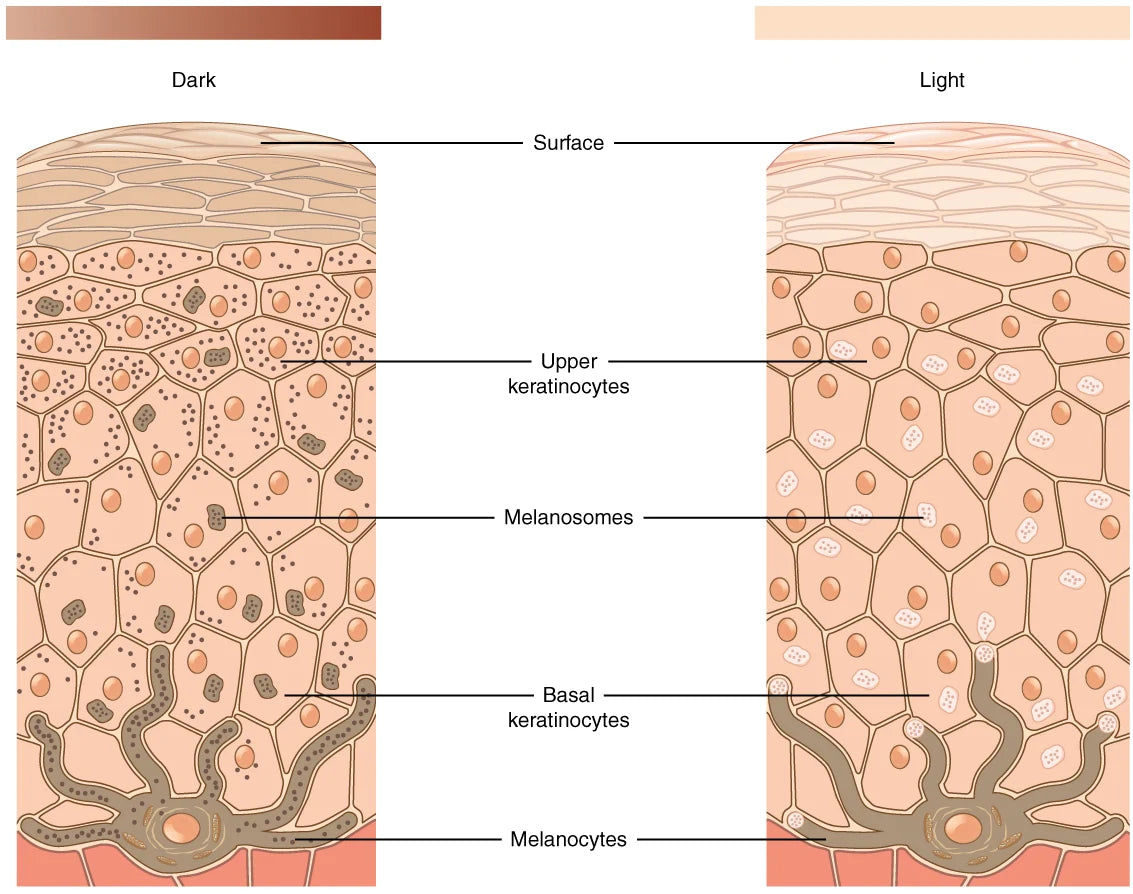
Melanocytes produce pigment and transfer it to surrounding cells. The diagram explains a mechanism; colour alone does not diagnose a dark spot.

Melanocytes produce pigment and transfer it to surrounding cells. The diagram explains a mechanism; colour alone does not diagnose a dark spot.

Image source · OpenStax CollegeCC BY 3.0Compressed display copy; illustration content retained.
Open full-size image ↗

Why can a spot leave colour behind?

Inflammation can stimulate pigment-producing cells. After the spot settles, extra pigment may remain, creating a common brown post-acne mark. Other marks look red or pink and relate more to blood vessels than the same pigment process. These can overlap, which is why the word marks alone is not enough to choose a treatment.

Dullness and scars are not synonyms for pigmentation

Dullness is an appearance description, not a diagnosis. Dryness can alter how the surface reflects light, and lighting itself changes a photo. A scar changes skin height, whereas a colour mark may be flat. Before buying, specify whether you mean a particular spot's colour, roughness, ongoing acne or a depression. This prevents choosing a product for the wrong task.

Start with the cause and protection

If acne continues, fading old colour alone will not prevent new marks. Ongoing friction or irritation can also be worsened by stronger exfoliation. Sun protection is central to managing uneven colour, and change takes time. For comparisons, photograph the same area at the same distance and lighting without filters; also record new marks rather than relying on mismatched before-and-after images.

Find the stratum corneum at the top and cell renewal below. This is thick skin, such as a palm; its clear lucidum layer is absent from facial skin.

Find the stratum corneum at the top and cell renewal below. This is thick skin, such as a palm; its clear lucidum layer is absent from facial skin.

Image source · OpenStax College: J. Gordon Betts, Peter Desaix, Eddie JohnsonCC BY 3.0Compressed display copy; illustration content retained.
Open full-size image ↗

Pigmentation describes a result, not its cause

Residual colour after acne is often post-inflammatory hyperpigmentation. Sun-related spots, melasma and marks after irritation may have different underlying processes. Not every dark area should be treated as the same condition or be expected to respond to one ingredient on one schedule. Look at distribution, appearance, timing, sun exposure and recent products when assessing the history.

Why the plan starts with protection

If acne, irritation and UV exposure continue, new marks may appear even while a brightening serum is used. Protect exposed skin properly, address ongoing triggers when possible and evaluate suitable treatment over a realistic period instead of expecting instant fading. A rapidly changing, bleeding or unusual-looking spot needs medical evaluation rather than cosmetic experimentation.


Sources and further reading

Is a mark fading, or is the lighting better?

Choose something specific to follow

Rather than rating glow in general, choose two or three existing marks and photograph the same sites consistently. Keep lighting, distance and angle stable and avoid beauty filters. Record new acne or irritation too, since new inflammation can change colour. Photographs help observation but cannot independently diagnose melasma or pigmentation type.

Addressing the cause matters as much as a fading product

Recurring acne needs an acne plan. Repeated inflammation from hair removal can keep marks returning. Sun protection is fundamental, and some melasma concerns benefit from appropriate visible-light protection as well. Choose pigment-focused ingredients according to the condition and tolerance rather than stacking acids because a mark has not quickly disappeared.

Separate colour from surface texture

A cheek has a flat mark and an old depression. The mark may fade while the depression remains; there is no contradiction. A cream may target colour while a scar needs another assessment. Conversely, moisturizing dryness can make a surface look smoother and brighter without a large pigment change. State exactly what improved rather than only saying lighter.

Case: two photographs with a dramatic-looking difference

Hana photographs a mark in sunlight, then a month later under warm bathroom lighting. This is not a reliable comparison. Light direction, white balance and camera exposure can make identical pigmentation appear lighter or darker.

Build a meaningful progress check

  1. Standardize location, lighting, distance and camera as much as possible.
  2. Take photos before shiny products or makeup, at sensible intervals.
  3. Track new marks as well as changes in older ones, not just a hand-picked best result.

Post-acne redness and later brown discoloration are different observations. Ongoing breakouts or unprotected sun exposure can also confound a brightening product evaluation.

Sources and further reading

Evaluating pigmentation: did the colour actually fade?

Define the feature being followed

Melanin is a natural pigment produced in specialized cells and transferred to other skin cells. Changes in production or distribution can make an area darker than its surroundings. A brown post-spot mark differs from flat redness, and both differ from a depressed scar. Colour measurement alone cannot describe a surface depression. Melasma involves multiple influences and can require a longer, professionally guided plan.

The melanocyte produces melanin and transfers pigment to neighbouring skin cells. Production and distribution both contribute to visible colour.

The melanocyte produces melanin and transfers pigment to neighbouring skin cells. Production and distribution both contribute to visible colour.

OpenStax College · CC BY 3.0 · Licence · Open the image to enlarge

A photograph can change while the mark does not

Brighter lighting, altered exposure, a filter or moisturizer reflection can make a face appear lighter. Photograph the same area with similar lighting, distance, angle and conditions, without filters. Compare the mark with nearby skin too: a brighter whole image does not prove selective fading. Home photographs are approximate tracking tools, not diagnosis or calibrated measurements.

Responder counts matter alongside an average

Teaching example: a 20% average improvement could mean similar changes for everyone or large changes in some people and none in others. The average alone cannot distinguish these patterns. Ask about sample size, withdrawals, reasons for leaving and how improvement was calculated. Showing only completers after irritated participants withdraw can make the result look better than the full experience.

Managing the trigger belongs in the outcome plan

If new acne continues, older marks may fade while new marks appear. Track these separately instead of declaring every pigment-focused step a failure. Sun protection and reduced irritation help limit repeated triggers. A new unusual or changing lesion needs medical assessment rather than an unplanned lightening experiment.

Measuring pigmentation: lighting and selection bias

Phone photos vary with illumination and white balance. Colour instruments can quantify defined properties under controlled conditions, but they still require consistent anatomical sites, setup and repeated measurements. Another major bias is selecting the most flattering before-and-after image rather than reporting all pre-specified outcomes.

Interpret a brightening trial

  1. Determine which pigmentation condition was studied and whether participants share the same underlying cause.
  2. Check whether sun protection and simultaneous acne treatment could influence results.
  3. Examine average change, variation between people and follow-up time, not one dramatic photograph.

A lower colour index can be relevant evidence, but it does not by itself establish mechanism or suitability for every kind of dark mark.

Sources and further reading
Educational diagram illustrating this lesson topic
Conceptual illustration, not a measured product-test result.

UNDERSTAND → APPLY

Identify the mark before choosing the ingredient

Post-acne marks, melasma, freckles and natural pigment variation are not interchangeable. Response differs by cause, and UV exposure can undermine an otherwise consistent routine.

Choose a specific target and compare photos under consistent light every few weeks. New or rapidly changing spots merit assessment.

Evidence for an ingredient does not automatically establish results for every finished product containing it.

\n\n
