
How your nose identifies a scent
SESH Academy / Fragrance Academy · Beginner
Understand odor receptors, learned associations and why perception varies.
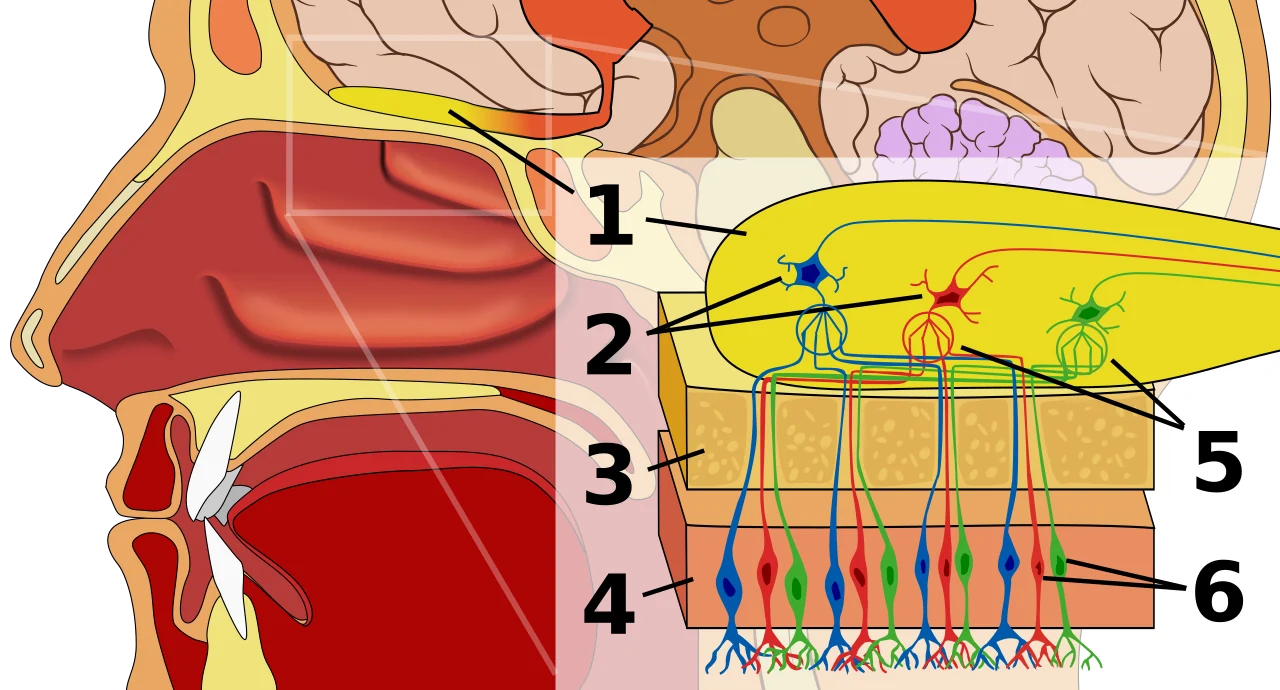
Follow the route from the nasal cavity to the olfactory bulb. Smell is perception; it does not independently identify a perfume’s ingredient list.

Odor starts with molecules
As a fragrance evaporates, odor molecules reach olfactory receptors high in the nasal cavity. There isn't a dedicated receptor for every 'rose' or 'pear'. Different molecules create patterns that the brain learns to associate with recognizable smells. Smell training therefore involves repeated observation and comparison, not memorizing a list of fragrance notes.
Memory helps you name smells
Familiar scents are easier to name: if you've smelled fresh orange peel many times, you may recognize its likeness in perfume. If you've never experienced vetiver on its own, identifying it from one complex fragrance is much harder. It's fine to call an impression 'dry woody' before learning a particular note label. Honest description beats unsupported ingredient identification.
Why people notice different notes
People differ in receptor sensitivity, learning, expectations and scent memories. One person may notice sweetness first while another notices florals. Neither necessarily has a faulty nose, and the bottle hasn't magically changed formulas. Fatigue, congestion and attention can also affect perceived odors.

Particles spread from higher to lower concentration. This is a qualitative model, not a perfume longevity timeline or a measured skin absorption rate.
Open full-size image ↗Your nose adapts to a constant smell
After ongoing exposure you may stop noticing your perfume as strongly even while other people can still detect it. This is olfactory adaptation. Don't automatically respray when your personal awareness drops. Coffee beans aren't a proven instant reset; a break and neutral air are more useful habits.
Try it yourself
Choose a familiar safe scent such as orange peel or mint and write three descriptors. Revisit after a short pause and compare; are you naming it more precisely?
• Choose a gentle, non-irritating smell.
• Never directly inhale concentrated oils or perfume spray.
• Record observed facets, not invented material names.
Check your reasoning: Fading awareness might mean adaptation, not necessarily complete disappearance from the room.

