
Lesson 2 of 2 in this stage
How does the nose build a mixture impression?
Understand masking and adaptation, and distinguish identifying a smell from detecting it.
A signal followed by interpretation
Sensory cells high in the nasal cavity respond to odorants. Signals travel to the olfactory bulb and brain regions involved in interpretation. The resulting experience depends on patterns, experience and attention, not one receptor for each marketing note name. Two people may detect the same smell yet label it differently.
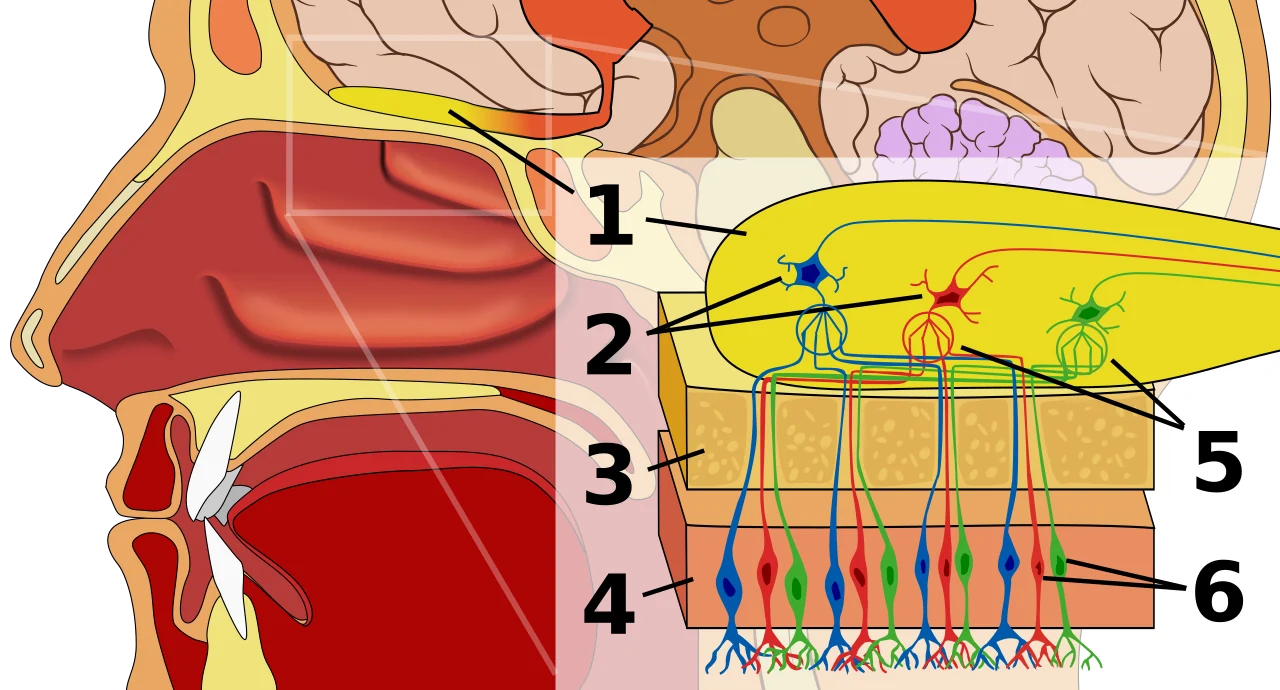
Start at the sensory cells high in the nasal cavity, then follow their connection to the olfactory bulb above. Signals begin here; identifying the smell involves brain interpretation.
Chabacano / Ignacio Icke, after Patrick J. Lynch · CC BY-SA 2.5 · Licence · Open the image to enlargeDetection is not identification
Detection asks whether a smell is noticeable. Identification asks what it is or resembles. A smell can be clear without being nameable. Choosing the scented strip is therefore different from naming every mixture component. Failure to label does not prove an absence of sensory input.
Suppression and adaptation change the picture
A component can become harder to identify in a mixture than alone, a form of mixture suppression. Continued exposure can reduce response or attention. Studies with defined mixtures found that adapting to one part can make another easier to identify. Perception can therefore change without a simultaneous chemical transformation in the bottle.
What does a trial establish?
Noticing an impression after a break that you missed during continuous smelling supports the importance of observation conditions. It does not diagnose olfactory function or calculate ingredient percentages. Use breaks and fresh air rather than a long sequence of sprays. New or persistent smell loss outside perfume testing warrants separate health assessment.
Mixtures change perception, not merely add odours together
Combining two aromatic materials can create an impression different from simply summing their separate descriptions. Masking occurs when one smell reduces another's perceptibility; adaptation describes how perception changes during repeated or prolonged exposure. Neither phenomenon by itself proves that a material vanished from a formula.
Test an accord without over-interpreting it
Separate two questions: can an observer detect that an odour is present, and can they identify its character? These are different tasks. Compare finished samples in short sessions with breaks and report the limits of your identification rather than claiming to know ingredient identities or concentrations.
Your turn
Use what you learned
Write one detection question and one identification question for a strip.
See the answer and why
Detection: 'Do you notice a smell?' Identification: 'What does it resemble?' Ask separately; naming difficulty is not absence of sensation.
Check your understanding
Answer four questions, then review the reason for each answer. You can retry.
Interpret the evidence
Odor mixture perception is non-additive: components may suppress or mask one another. Analyse both character and intensity, and compare against a reference blend rather than merely summing note lists.
SESH exercise: choose two scents and record results before viewing their marketing descriptions.


