SESH Academy

Full topic reading

From the basics to the details

The skin barrier: how skin holds on to water

Skin is more than a covering

Skin has layers. The epidermis is the outer layer; beneath it, the dermis contains vessels, nerves and glands. In skincare, the barrier usually means the outer epidermis, especially the stratum corneum. Flattened cells and surrounding lipids help limit water loss and exposure to irritants. This is a regulating system, not a wall that blocks everything.

Find the stratum corneum at the top and cell renewal below. This is thick skin, such as a palm; its clear lucidum layer is absent from facial skin.
Find the stratum corneum at the top and cell renewal below. This is thick skin, such as a palm; its clear lucidum layer is absent from facial skin.

Image source · OpenStax College: J. Gordon Betts, Peter Desaix, Eddie JohnsonCC BY 3.0Compressed display copy; illustration content retained.
Open full-size image ↗
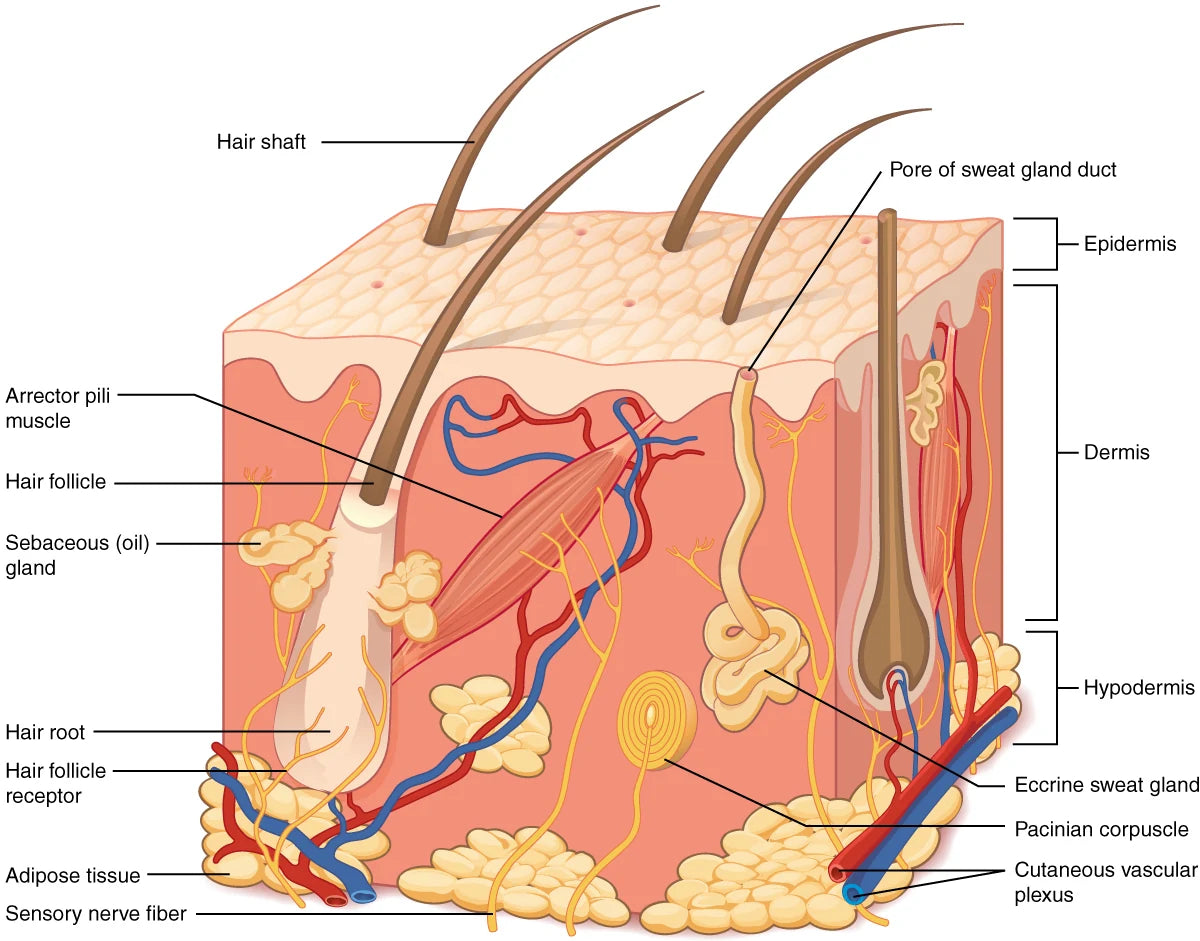
Find the outer epidermis and the dermis beneath it. This locates the surface barrier within the skin.

Find the outer epidermis and the dermis beneath it. This locates the surface barrier within the skin.

OpenStax College: J. Gordon Betts, Peter Desaix, Eddie Johnson · CC BY 3.0 · Licence · Open the image to enlarge

Why can shiny skin still feel tight?

The oil you see on your face comes from sebaceous glands. Water within the outer skin is a different thing. Shine can therefore coexist with low hydration or irritation. Tightness alone is not a diagnosis: a cleanser, weather or a skin condition can contribute. Note when it began and what changed before treating every tight feeling as a dry skin type.

Care that supports the barrier

Cleansing removes the day's residue, but clean skin need not feel tight. Moisturizer helps retain water and improves surface feel. If a new exfoliant causes stinging or peeling, stop the suspected product, pause optional irritating steps and use a simple routine you already tolerate. Do not scrub off flakes to remove a supposedly damaged layer. Persistent pain, rash, swelling or painful cracks need medical assessment rather than another serum.

Skin anatomy: the epidermis sits above the dermis, with follicles and glands at different depths. Location explains a skincare target; it does not prove that a product reaches every layer.

Skin anatomy: the epidermis sits above the dermis, with follicles and glands at different depths. Location explains a skincare target; it does not prove that a product reaches every layer.

Image source · OpenStax College: J. Gordon Betts, Peter Desaix, Eddie JohnsonCC BY 3.0Compressed display copy; illustration content retained.
Open full-size image ↗

Understand the barrier as a water-management system

The stratum corneum contains cohesive cells surrounded by organized lipids, including ceramides, cholesterol and fatty acids. This structure limits water loss and reduces exposure to certain irritants. Natural moisturizing factors inside cells attract and hold water, which is different from the lipids that help slow its escape. That is why a useful moisturizer may combine water-binding ingredients, surface-softening ingredients and components that reduce water loss. A watery serum alone is not a complete definition of barrier care.

Separate an observation from a diagnosis

Tightness immediately after cleansing tells you when a symptom appeared; it does not diagnose your permanent skin type. Stinging from a previously comfortable product may suggest irritation, but it does not prove a particular barrier disorder. Check recent changes such as stronger cleansers, repeated exfoliation and hot water. Persistent rash, painful cracks or worsening symptoms deserve medical assessment.

A practical decision sequence

  1. Pause new optional products that coincide with stinging or peeling.
  2. Return to a gentle cleanser, a short routine and a moisturizer you previously tolerated.
  3. Once comfortable, reintroduce optional products gradually, one at a time, so a recurrence is easier to interpret.

If symptoms persist or intensify, seek a dermatologist rather than continuing product experiments.

Connect the concept to actual ingredients

Differentiate a water-binding humectant such as glycerin, a barrier lipid such as ceramides, and ingredients that limit surface water loss. The finished formula matters more than an isolated ingredient name.

SESH example

Nighty Night Cream contains glycerin and niacinamide alongside other moisturising ingredients. Always assess the complete INCI list rather than a single highlighted active.

Related SESH references: Nighty Night Cream · Niacinamide · Ceramide NP

Sources and further reading

An oily nose and tight cheeks: what should you change?

Read the whole situation

Basma usually has shine on her forehead and nose, with comfortable cheeks. She switches to a cleanser that leaves her face tight, then her cheeks start flaking. The first observation suggests a combination pattern; the second is a new product-related change. Both can be true. An oily nose does not mean the whole face needs a stronger cleanser.

A plan she can actually follow

If the new cleanser causes discomfort, stop it and return to a tolerated cleanser or choose a gentle alternative. Use a comfortable moisturizer, with a little more or a richer texture on the cheeks if needed. Keep suitable sun protection. Do not add acids to tackle nose shine while the face is irritated. Area-based care does not require five products; adjusting amount may be enough.

How should she judge the change?

Track cheek comfort separately from T-zone shine. If the cheeks improve while the nose keeps its usual oiliness, the first plan has not failed: its purpose was comfort, not changing skin type. Persistent tightness or a rash needs reassessment. Blotting paper detects surface oil; it does not test allergy or skin water content.

Case: a shiny forehead and tight cheeks

Nada sees shine on her forehead and nose late in the day, but her cheeks feel tight after each wash. Before labeling this “combination skin,” ask how long the tightness lasts, which cleanser she uses and whether it started after a product change. An oily T-zone can coexist with irritation or reduced hydration elsewhere.

A decision plan, not two complete routines

  1. Use a gentle cleanser across the face and track post-wash tightness.
  2. Try a light moisturizer overall, using more on the cheeks if needed.
  3. Observe the pattern across approximately two comparable weeks instead of judging one photograph.

Measure success: cheeks feel comfortable without excessively stripping the T-zone, not the elimination of every trace of sebum.

Sources and further reading

The barrier: hydration and water loss are different measurements

How does skin retain water?

Compact surface cells and the lipids between them slow water escape. Cells resemble bricks and the surrounding lipids resemble mortar, but skin is a renewing tissue rather than a rigid wall. Humidity, cleansing and friction affect its behaviour. Intercellular lipids include ceramides, cholesterol and fatty acids; they differ from the sebum responsible for surface shine.

Find the outer epidermis and the dermis beneath it. This locates the surface barrier within the skin.

Find the outer epidermis and the dermis beneath it. This locates the surface barrier within the skin.

OpenStax College: J. Gordon Betts, Peter Desaix, Eddie Johnson · CC BY 3.0 · Licence · Open the image to enlarge

Two measurements answer different questions

MeasurementMeaningWhat it cannot establish alone
Surface hydrationAn estimate of outer-layer water content, often using electrical propertiesThat barrier structure has returned to normal
Transepidermal water loss, TEWLThe rate of water-vapour escape through skinThe cause of a change, skin comfort or resolution of inflammation

A rapid improvement does not identify the mechanism

A surface film can reduce water escape quickly, while a humectant can increase measured hydration. Both may help, but neither alone proves that intercellular lipids have been rebuilt. For a barrier-repair claim, ask what was measured, when and against which control. Temperature, humidity and time since washing also matter; changing them can alter a reading without changing the product.

Read a percentage with its baseline

Teaching example: water loss falls from 20 to 15 units. That is a reduction of 5 units, or 25% of baseline. If a control area falls from 20 to 18 under the same conditions, some improvement occurred without the tested product. Do not translate this into '25% repaired skin': the percentage describes the measurement.

Hydration measurement is not the same as water-loss measurement

Surface hydration instruments that rely on capacitance detect changes associated with water in the stratum corneum. Transepidermal water loss (TEWL) instead estimates the rate at which water escapes through the skin under measurement conditions. More surface hydration does not automatically establish lower TEWL, and the reverse is also true. Temperature, humidity, sweat, anatomical site and timing after moisturizer application can affect both measures.

Read a “barrier repair” study critically

  1. Identify the primary outcome and whether the test compared a vehicle or meaningful reference product.
  2. Check whether effects persisted beyond the immediate post-application window.
  3. Examine effect size, variability and sample size, not simply statistical significance.

An increase in hydration after a cream is applied does not by itself prove that intercellular lipids were rebuilt or that a skin disease was treated.

Sources and further reading
Educational diagram illustrating this lesson topic
Conceptual illustration, not a measured product-test result.

UNDERSTAND → APPLY

Understand the barrier, not just the label

The stratum corneum consists of cells surrounded by lipids that help regulate water loss. Overcleansing or excessive exfoliation can cause tightness and stinging even on oily skin.

Worked example: if tightness begins after switching cleansers, reduce irritation and use a comfortable moisturizer before adding more acids. Feeling better does not by itself prove complete barrier recovery.

Track post-cleansing comfort, stinging and moisturizer needs for a week. Persistent pain or a rash warrants medical assessment.

\n\n

