
Lesson 1 of 3 in this stage
The barrier: hydration and water loss are different measurements
Understand what a hydration test measures and what it cannot establish about barrier repair.

Find the stratum corneum at the top and cell renewal below. This is thick skin, such as a palm; its clear lucidum layer is absent from facial skin.
How does skin retain water?
Compact surface cells and the lipids between them slow water escape. Cells resemble bricks and the surrounding lipids resemble mortar, but skin is a renewing tissue rather than a rigid wall. Humidity, cleansing and friction affect its behaviour. Intercellular lipids include ceramides, cholesterol and fatty acids; they differ from the sebum responsible for surface shine.
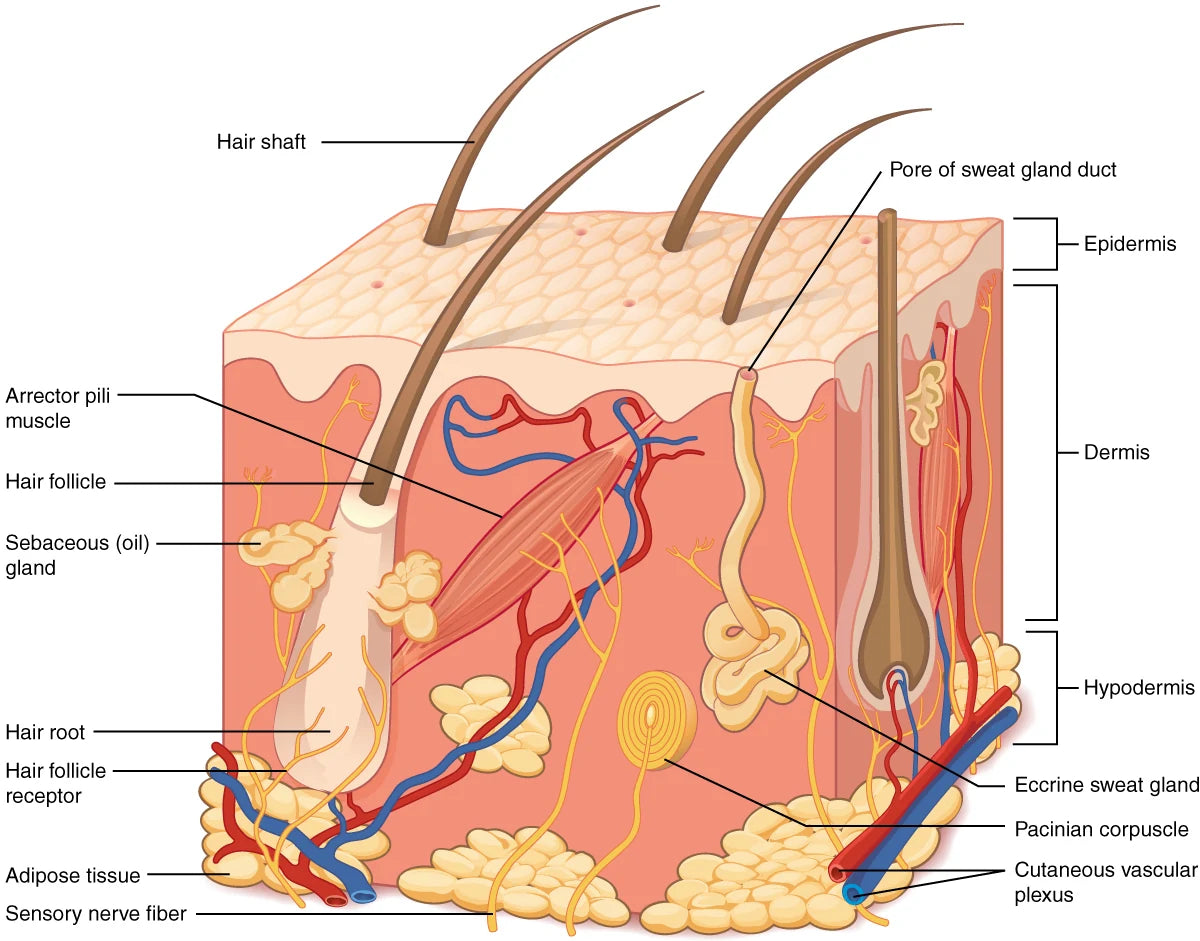
Find the outer epidermis and the dermis beneath it. This locates the surface barrier within the skin.
OpenStax College: J. Gordon Betts, Peter Desaix, Eddie Johnson · CC BY 3.0 · Licence · Open the image to enlargeTwo measurements answer different questions
| Measurement | Meaning | What it cannot establish alone |
|---|---|---|
| Surface hydration | An estimate of outer-layer water content, often using electrical properties | That barrier structure has returned to normal |
| Transepidermal water loss, TEWL | The rate of water-vapour escape through skin | The cause of a change, skin comfort or resolution of inflammation |
A rapid improvement does not identify the mechanism
A surface film can reduce water escape quickly, while a humectant can increase measured hydration. Both may help, but neither alone proves that intercellular lipids have been rebuilt. For a barrier-repair claim, ask what was measured, when and against which control. Temperature, humidity and time since washing also matter; changing them can alter a reading without changing the product.
Skin anatomy: the epidermis sits above the dermis, with follicles and glands at different depths. Location explains a skincare target; it does not prove that a product reaches every layer.
Read a percentage with its baseline
Teaching example: water loss falls from 20 to 15 units. That is a reduction of 5 units, or 25% of baseline. If a control area falls from 20 to 18 under the same conditions, some improvement occurred without the tested product. Do not translate this into '25% repaired skin': the percentage describes the measurement.
Hydration measurement is not the same as water-loss measurement
Surface hydration instruments that rely on capacitance detect changes associated with water in the stratum corneum. Transepidermal water loss (TEWL) instead estimates the rate at which water escapes through the skin under measurement conditions. More surface hydration does not automatically establish lower TEWL, and the reverse is also true. Temperature, humidity, sweat, anatomical site and timing after moisturizer application can affect both measures.
Read a “barrier repair” study critically
- Identify the primary outcome and whether the test compared a vehicle or meaningful reference product.
- Check whether effects persisted beyond the immediate post-application window.
- Examine effect size, variability and sample size, not simply statistical significance.
An increase in hydration after a cream is applied does not by itself prove that intercellular lipids were rebuilt or that a skin disease was treated.
Your turn
Use what you learned
TEWL falls from 30 to 24. Calculate the percentage reduction and identify one question needed before attributing it entirely to the product.
See the answer and why
The reduction is 6/30 = 20%. We need, for example, the control area's result under matched conditions. This is a water-loss reduction, not proof of 20% skin repair.
Check your understanding
Answer four questions, then review the reason for each answer. You can retry.


